We live along the Tennessee River on the banks of Kentucky Lake. Kentucky Lake was formed in the 1940’s when the Tennessee Valley Authority built a lock and dam to raise the Tennessee River to accommodate larger barges carrying coal, steel and bulk products on the river. The barge traffic travels all the way to Chattanooga. Where we live, the lake is about a mile wide. Lots of barge traffic and fishing boats. One of my favorite activities is to take the runabout on the river to experience life on the water. Every day we see something unusual. This last trip in the middle of March was no exception.
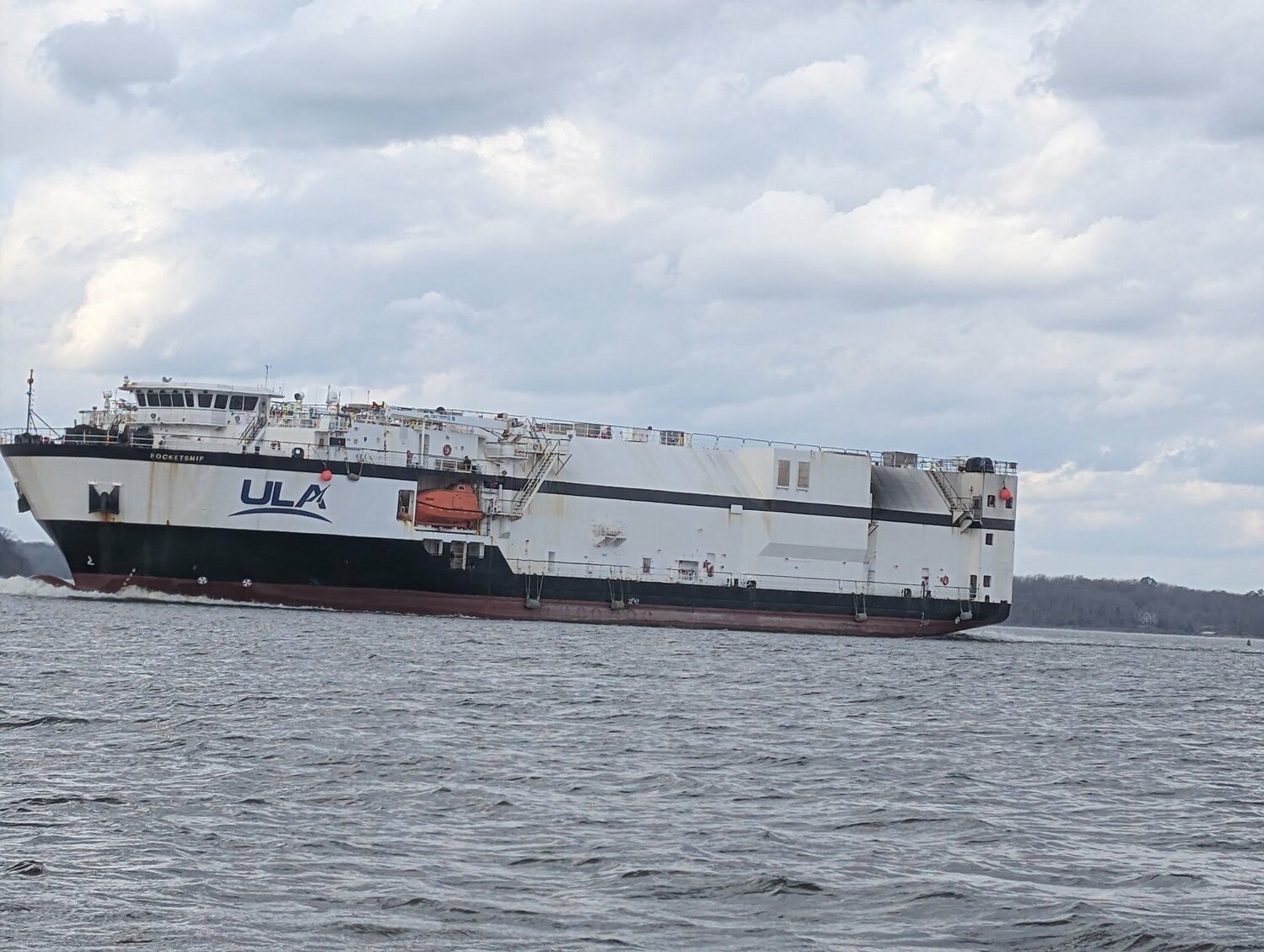
We were heading downstream to eat lunch at the Burger Barn at KenLake Marina, a little more than an hour down river. We noticed a white object a few miles ahead on the river and assumed it was one of the tug boats pushing a barge. The closer we got, the bigger it got. I have never seen an ocean-going vessel on the river. There are river cruise boats on the lake but not this large. As we passed the vessel I had to circle around and follow it, taking a closer look. There was an orange totally enclosed sea worthy lifeboat on each side of the ship. I knew this was no river boat. My wife looked up the name on the side and we were surprised to discover what it actually was.
The United Launch Alliance Rocket Ship is a 312’ cargo vessel that transports space rocket components from the 1.6 million sq. ft. production facility in Decatur, Alabama to Cape Canaveral, Florida. It is 82’ wide and 50’ high with a draft of 15’. It weighs 9,500 tons and carries Atlas V, Delta VI and Vulcan Centaur boosters, second stages and payload fairings in an environmentally controlled setting. The rockets are rolled in on semi-trailers through the 80’ wide fold down ramp at the aft for the ship. It is the only United States flagged ship with the capability to transport rockets on both rivers and open ocean. It is powered by two General Motors G7A engines developing 4,000 horsepower each and four Caterpillar generator engines of 831 horsepower each to maintain the A/C for the cargo hold and a 371 horsepower emergency Caterpillar engine. The fuel capacity is 163,800 gallons of diesel.
The ship requires a crew of 16 to operate and has living quarters, dining area, helicopter pad, below deck machine shop and the most sophisticated computers and navigational system available. The officers are assigned four-hour shifts while on the river and eight hour shifts in the open sea, and two experienced river pilots come on board to guide the boat while inland. There is a cook and assistant to serve meals during the eight day/4,336 mile one-way trip from Decatur to Cape Canaveral Space Force Station. The Rocket Ship has been in constant service since 1999 and a 356’ sister ship has just been built and will enter service this spring.
Now more on the sophisticated navigation system. On August 7, 2001, the Rocket Ship ran aground on a sand bar on the Tennessee River and had to be freed by a tugboat. On January 26, 2012 the Rocket Ship struck the Eggner’s Ferry Bridge on the Tennessee River, which is about five miles from where we encountered the ship. The crew was operating in a recreational channel rather that the shipping channel at the time and destroyed a 322’ section of the bridge. The pilot’s failure to use all available navigational tools was found to be the cause of the accident, while ignoring two coast guard broadcasts and a radio call from a nearby ship. The bridge built in 1932 was scheduled for replacement and the incident sped up the schedule for the construction which was completed in 2016. Had we known all that, we might have given the Rocket Ship a wider berth when we passed by.